Fresco Was Right (We Just Didn’t Like the Smell)
Over a decade ago, I sat in a draughty concert hall listening to Jacque Fresco talk about automation, resource-based economies, and a world where scarcity was solved by design, not luck or exploitation. At the time, it sounded abstract — almost comic. Utopian. But I was captivated by the possibility.
(Fun fact: “utopia” literally means “no place.”)
He painted this picture of a society freed from labour, where machines did the boring bits and humans were left to think, create, and maybe even be decent. And yet, the smell I’m breathing now? It’s a warning, not a promise — this isn’t utopia. It’s unemployment with better branding, and it’s spreading faster than anyone wants to admit.
In my industry, AI isn’t a theory. It’s a replacement. Not tomorrow, not next year — now. Algorithms spit out work. Code makes decisions. Creativity’s reduced to prompts, and a middle-aged man like me can design and build a blog with barely any HTML. Every role, every skill, every carefully honed judgment is being eaten alive by something that doesn’t need sleep, negotiation, or excuses — and it won’t stop at us.
Fresco warned about this — not just the tech, but the imbalance. If we don’t redesign the system, technology won’t set us free; it’ll simply make old hierarchies more efficient. Power doesn’t need to listen when it owns the servers. We used to think the danger was machines replacing us. Turns out it’s power rewriting reality while we sleep.
The Government?
It’ll do what governments do — patch the leak, write the press release, talk about retraining programs and pilot initiatives. Retraining for what, though? The machines are learning faster than we are. Every minister’s speech sounds like a marketing brief written by ChatGPT or some other generative tool. Every “solution” is just deodorised panic, a placebo for the human mind.
And here’s the real existential hit: AI will expose the fundamental flaw in capitalism. It relies on consumption. If nobody has money because nobody has jobs, consumption — the largest constituent of GDP — evaporates. Taxes vanish. Revenues shrink to a trickle. Without that, there are no organs of the State. No welfare. No NHS. No police. Nothing.
This isn’t just economic collapse. It’s cultural, societal, existential. The work that gave us identity, purpose, meaning — gone. Generations waking up to find their usefulness is a rounding error in a quarterly update. Entire professions evaporating quietly. And the concept of money itself? Redundant. Capitalism kills itself. The irony is almost funny, if you could still laugh.
Algorithmic Takeover.
Art, journalism, advertising — all the things we told ourselves were uniquely human— are being rewritten by code. And it’s not stopping there. The contagion spreads like a virus, mutating across sectors. Teachers, doctors, lawyers, civil servants — professions built on judgment, empathy, discretion — all quietly being hollowed out by systems that promise efficiency and deliver sterility.
The NHS already runs on algorithms that decide who’s seen and who’s not; legal firms are feeding decades of casework into databases that write their own precedents; governments automate welfare checks, border controls, policy briefs. Even ministers read speeches they didn’t write, drafted by aides who ran out of time and fed a prompt instead.
Every institution that once depended on people is turning itself into code. Every safeguard that relied on conscience is being rewritten as logic. Humanity itself is being digitised, reduced to inputs, outputs, and metrics.
No industry is safe because efficiency has no loyalty. It doesn’t care if you heal, teach, or protect. It doesn’t even care if you mean well. It only cares that you’re cheaper replaced than retained. The machine doesn’t negotiate, sympathise, or hesitate. You’re obsolete before you even realise it.
Another Hierarchy.
Fresco once imagined machines liberating us. But liberation without equality is just another hierarchy. And this one’s invisible — buried in lines of code, owned by a handful of men who don’t even need to pretend to be good anymore.
Maybe governments will implement some of his thinking — resource-based economies, universal income, automation taxes. But let’s be honest: by the time they do, the decisions will already be automated. The future’s not being built in parliaments. It’s being written in syntax. Humanity has ceded the architects’ seat to lines of code.
Global Failure, or Collective Survival?
AI isn’t local. Capital moves at the speed of code. If one country tries to slow it down, it’ll just flee to the next. Shareholder dividends must be protected, after all — efficiency doesn’t negotiate, morality doesn’t compute. Without global coordination, every nation will face the same existential threat individually, and each will look the other way for a short-term gain.
If humanity is to survive the AI revolution, countries need accords — treaties acknowledging that AI is the single most impactful development in human history. And not just vague guidelines: phased implementation over decades, enough time for societies to transition, retrain, redistribute, rethink work, and redefine purpose. Generational planning. Strategic restraint.
Without it? We will end up truly and utterly fucked. Not just obsolete, not just jobless, but living in a world where code determines every function of human life, and no government has the tools or resources to intervene.
Economic Apocalypse, By the Numbers.
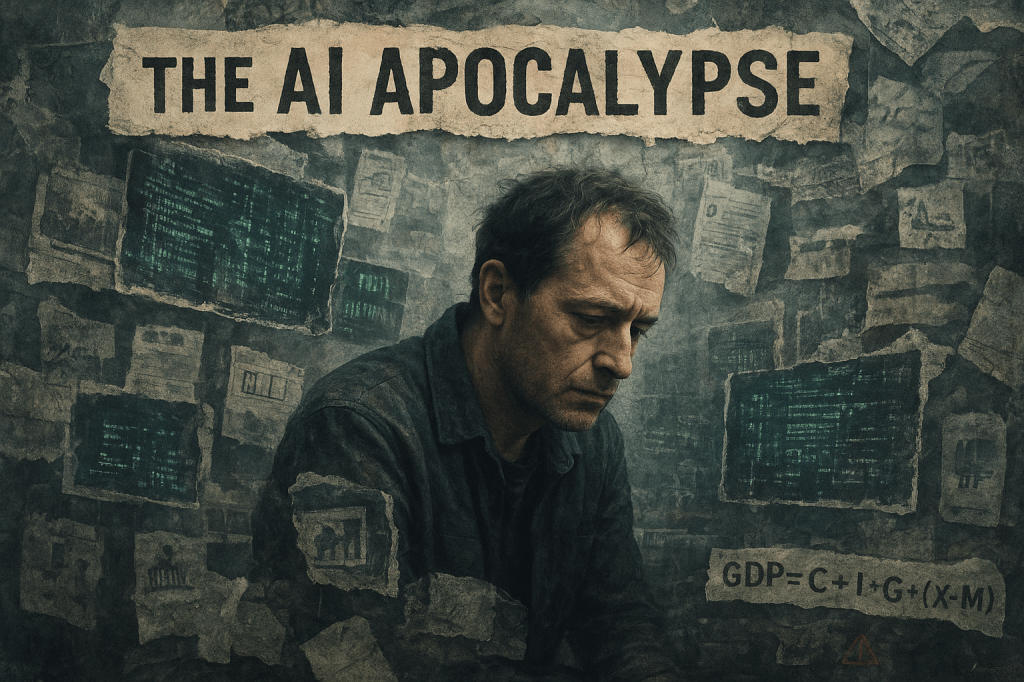
Let’s get proper about this. GDP = C + I + G + (X-M).
C = consumption — the goods and services we buy. The single largest contributor to a country’s GDP.
I = investment — corporate or government investment.
G = government expenditure — wages, infrastructure, welfare.
X-M = exports minus imports — the balance of trade.
If you fuck C, which AI will by displacing jobs, you fuck GDP, and everything else collapses with it. No tax revenues → no government spending → no welfare, no NHS, no police. Investment dries up. Exports suffer because no one can buy. You bankrupt a nation, and it collapses quietly, invisibly, like a house of cards under a very polite breeze.
Scale it globally and the nightmare compounds: every economy simultaneously in freefall, every state powerless to intervene because capital and code move faster than borders. The apocalypse doesn’t roar — it updates itself.
Living Obsolete Through a Quiet Replacement.
The end of work won’t arrive with sirens or smoke. It’ll come quietly, with software updates, disappearing paychecks, and declining relevance. The apocalypse won’t feel like an explosion. It’ll feel like being politely erased from existence. Entire industries, entire lifetimes, ghosted by code. Who controls the resources will matter more than anything else — because money itself will be meaningless, and survival will depend on access, not employment.
Until then, I’ll keep doing what I can: smelling the shite, naming it, and writing about it — before the machines learn to fake that too.
— Tom Kite.
 Everyone’s talking shite. I’m just breathing it in.
Leave a comment