When I was young, I spent nights out in a haze of curiosity and poor decisions, flirting, wandering, a little promiscuous with nothing but time and a weak liver.
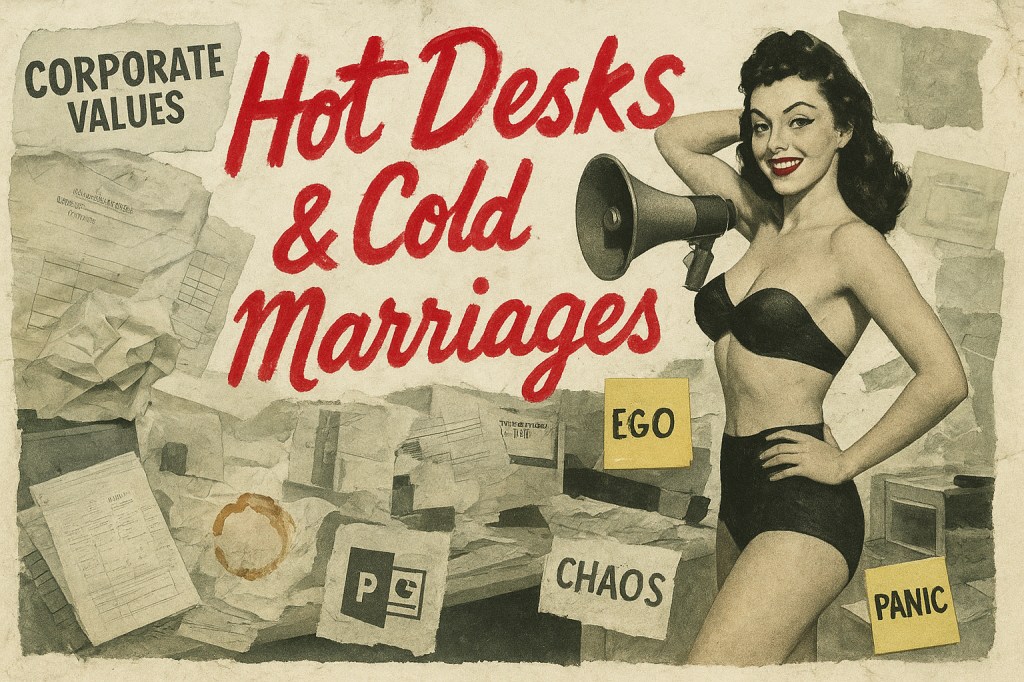
Now, older, slower, married, I watch chaos happen indoors, fluorescent-lit, over-brewed coffee in hand, where the thrill is replaced by whispers in stairwells, secret lunches, and the faint chemical trace of fear in the printer room.
Office affairs. The quiet little explosions that make a building hum like it’s about to implode.
I’ve seen a lot in offices. I’ve smelled a lot. And let me tell you — office affairs aren’t about sex. Not really. They’re about ego, control, desperation, and the absurd lengths humans will go to pretend they’re not lonely, incompetent, or desperately chasing attention. They’re collisions that leave budgets shredded, deadlines blown, and PowerPoints looking like the aftermath of a car crash.
The Proximity Effect.
The biggest driver isn’t lust. It’s proximity.
You see each other every day — tired, caffeinated, stressed, pretending to care about the same spreadsheet. You see the best and the worst: the presentation high, the client meltdown, the 4pmsugar crash. The pressure from home fades; the office becomes its own small planet with its own weather system.
And in that sealed atmosphere, things distort. People who’d never glance twice at each other in real life suddenly orbit closer. They mistake shared pressure for chemistry, shared targets for destiny. The fluorescent lighting softens the edges; the endorphins of a half-won pitch feel like love.
It’s not about attraction. It’s about context.
Roles, reputations, and workplace masks do strange things. People perform competence, kindness, authority, rebellion — whatever the culture demands. That performance becomes magnetic. The version of them you fall for isn’t quite real; it’s the corporate avatar, polished by purpose and deodorant.
It’s a kind of false intimacy — born from proximity, nurtured by routine, and doomed by reality. The workday ends, the spell breaks, and everyone goes home smelling faintly of toner and regret.
The Gossip Explosion.
It starts as a flicker — someone lingers too long at the printer, a hand brushes a shoulder, a calendar block appears at 3pm with no explanation. Nothing seems amiss. But if you’re paying attention, the smell hits your nose like a rotten orange.
By morning, it’s a murmur in the elevator: “Did you see…?”
By lunch, it’s loud enough to make you spill your tea.
By 3pm, half the office thinks they know the story, the other half invents their own details. HR quietly gnaws on the leg of a chair, wondering why anyone ever promoted them. By 5pm, everyone is a character in a soap opera nobody scripted. Details mutate, locations misremembered, motives embroidered. Somewhere, a team project dies quietly while everyone watches.
Affairs in the office are like a slow chemical reaction in a test tube. Add proximity, add ambition, add boredom, stir in a little loneliness, and leave unattended for a few weeks. The reaction is unpredictable. Sometimes it fizzles. Sometimes it explodes. And if it explodes, it leaves the entire company smelling faintly of panic, testosterone, perfume, and failure.
Intersecting Chaos.
Let me set the scene:
- Employee X — always impeccably dressed, walks like they own the company (and secretly the hearts of half the office).
- Employee Y — charming, older, slightly chaotic, the kind of person who once sold sand to a camel and made it feel like a privilege, now basking in old glory and trying to stay relevant.
- Employee Z — observes everything, remembers everything, probably writing a novel in their head about the moral bankruptcy surrounding them.
Employee X and Employee Y meet in the break room — just a casual chat, obviously, but their hands linger near the coffee machine, their laughter has a subtle edge that says: yes, we know the world is watching. Meanwhile, Employee Z sees it all, whispers to the intern who whispers to the receptionist who whispers to anyone within a 50-foot radius.
By Thursday, the rumours have mutated. The “just coffee” becomes a “three-hour meeting in the boardroom,” which transforms into “helicopter rides, weekend getaways, corporate credit cards misused.” HR want to know nothing (of course), and everyone carries on as though nothing happened, even as the office hums with tension so thick you could spread it on toast.
Analogies of Absurdity.
Office affairs are like:
- Egg sandwich in the fridge for three weeks: everyone notices, no one admits it, but the smell gets stronger and more intolerable.
- A tightrope walker on a wet noodle: wobbling, chaotic, about to fall, yet somehow still moving forward while everyone watches in horrified fascination.
- PowerPoint slides after a tornado: half the content is gone, the rest scattered, but everyone pretends it’s meaningful.
- A photocopier jam during a budget review: screaming, whirring, sticky, but ignored because pretending it doesn’t matter is cheaper than fixing it.
And yet, the people involved carry on as if they’re characters in a private movie nobody else is allowed to see. Lunch breaks are clandestine rendezvous; emails carry double meanings; meetings staged like theatre. Deadlines collapse, performance suffers, HR is still checking hand sanitizer levels like that will fix anything.
The Subtle Horror and Delight.
Here’s the thing: the office is a Petri dish for human absurdity. Ego, desire, ambition, incompetence — all growing together, invisible unless you pay attention. Everyone smells the chaos. Some hide it. Some amplify it. Some ride it like a wave, laughing maniacally while the rest of us duck for cover.
You’ll notice the patterns:
- Overly kind behaviour in the morning, suspicious emails by afternoon.
- Managers preaching boundaries while secretly orchestrating personal chaos.
- Interns documenting everything with more accuracy than the auditors.
- Coffee stains on financial reports, sticky notes with half-formed confessions, chairs mysteriously relocated.
And it’s beautiful in its awful way. Office affairs aren’t scandal. They’re a reminder that humans are messy, flawed, desperate, and brilliant in the same breath. Gossip is the soundtrack, whispered secrets the décor, chaos the only constant.
Lessons From the Trenches.
- Notice it. Don’t pretend it isn’t happening. Smell the perfume, the anxiety, the ambition.
- Laugh at it. Loudly, quietly, violently, subtly — your choice. It’s absurdity distilled.
- Keep your distance. Participation optional. Observation mandatory.
- Learn humility. Everyone’s full of shite. From the CEO to the intern, no one escapes.
- Enjoy the chaos. Humanity is beautiful when messy, and the office is a masterclass in disaster.
So next time someone lingers by the printer, a calendar slot appears without explanation, or a lunch break stretches suspiciously, breathe deep. Observe. Take notes. Maybe laugh quietly while the office implodes around you.
Because office affairs are not scandal — they’re life, in miniature, messy, absurd, and utterly human.
— Tom Kite.

 Everyone’s talking shite. I’m just breathing it in.
Leave a comment